
Last Updated: October 30, 2026
Quick Summary
Eye exams feel rushed mainly because clinics book patients back-to-back, run automated pre-testing first, and leave little time for questions, so the optometrist is often seen only for the final minutes. Anxiety also makes time feel shorter and questions feel awkward to ask. Ask how long your slot is and what the optometrist will personally do.
- A clinic booking patients every 15 minutes has no room for a slow, careful exam.
- Much of an eye exam often involves pre-testing with automated instruments before the optometrist sees you.
- A ten-minute visit with only a chart and an autorefractor is a screening, not a comprehensive exam.
- Bring your current glasses, a medication list, and written questions to make the visit feel calmer.
- Ask how long your appointment slot is and whether eye pressure and retina checks are included.
Table of Contents
- Why Your Eye Exam Feels Rushed: 7 Common Reasons
- How Long Does an Eye Exam Take?
- What Happens During an Eye Exam
- How to Prepare for an Eye Exam
- Questions to Ask Your Optometrist
- Book a Comprehensive Eye Exam at Alcona Eye Care
- Frequently Asked Questions
Why Your Eye Exam Feels Rushed: 7 Common Reasons
If your eye exams feel rushed, you are not imagining it. Patients often describe this feeling after years at other clinics, and the reasons are rarely about how much the optometrist cares. They are about schedules, equipment, and how clinics run their day. Below, we break down the seven reasons an exam can feel hurried, explain how long a proper exam should take, and show you exactly what to ask so you leave with answers.
Here are the seven reasons, in the order we see them most often:
- Back-to-back booking. A clinic that books patients every 15 minutes has no room for a slow, careful exam.
- The pre-test relay. Automated machines run first, and the optometrist only sees you for the final minutes.
- Complicated prescriptions. A big change in your vision takes more testing, and some visits are not scheduled for that.
- Silent clinicians. Some optometrists work quietly and explain little, which feels like speed even when it is not.
- Your own nerves. Anxiety makes time feel shorter and questions feel awkward to ask.
- Short appointment slots. A vision screening is not a comprehensive eye exam, but they can feel the same in the chair.
- No time for questions. If the schedule leaves no room for discussion, you leave with doubts.
The Psychology Behind the Rushed Feeling
Time feels shorter when you are anxious and under-informed. That is not a flaw in you; it is how attention works. Patients who do not know what a test measures often read a quiet room and a fast machine as “they are skipping things.”
There is a second factor. A comprehensive exam includes several short tests. The pace can feel brisk, and that can look like haste to someone watching from the chair.
So before you assume the worst, check the checklist. Then ask. A good clinic will walk you through each step without defensiveness.
Here are the seven reasons an eye exam can feel hurried, in the order the article lists them.
| Reason | What it looks like |
|---|---|
| Back-to-back booking | Patients booked every 15 minutes |
| The pre-test relay | Machines run first; optometrist seen for final minutes |
| Complicated prescriptions | Big vision change needs more testing than scheduled |
| Silent clinicians | Quiet optometrists explain little, which feels like speed |
| Your own nerves | Anxiety makes time feel shorter and questions awkward |
| Short appointment slots | Vision screening feels like a comprehensive exam |
| No time for questions | Schedule leaves no room for discussion |
How Long Does an Eye Exam Take?
The difference matters. A screening checks how well you see. A comprehensive exam also checks ocular health, eye pressure, the retina, and how your eyes work together.
But here is the part that explains the rushed feeling: the 30 to 45 minutes is rarely spent with the optometrist.
That is not corner-cutting. Modern diagnostic technology can make some steps of an eye exam quicker and more detailed than older manual methods.
The trade-off is transparency. Speed that comes from better instruments is good. Speed that comes from a short appointment slot is not.
A ten-minute visit with only a chart and an autorefractor is a screening, not a comprehensive exam, regardless of what the booking was called. If you have risk factors such as diabetes, a family history of glaucoma, or a recent change in vision, that is not enough.
If your last exam was over in ten minutes and involved only a chart and a machine, you likely had a screening, not a full exam. How often you should get an eye exam depends on your age and health factors. That is worth knowing before you book.
What Happens During an Eye Exam
A comprehensive eye exam is a set of short tests that check your vision, your eye health, and how your eyes work together. No single step takes long, but together they give the optometrist a full picture.
Expect most of these:
- Case history. Your symptoms, screen time, health conditions, and medications.
- Visual acuity. Reading letters at a distance and up close to measure sharpness.
- Refraction. Lenses flipped in front of your eyes to find your prescription update.
- Eye pressure check. A quick puff or a gentle touch test for glaucoma risk.
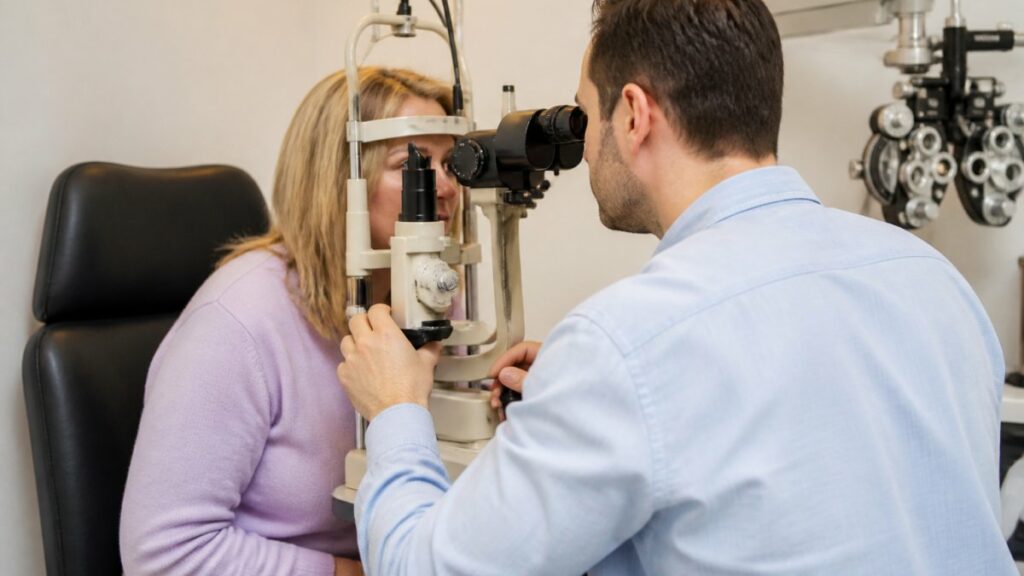
- Slit lamp exam. A close look at the front of your eye.
- Retinal check. A look at the back of your eye, sometimes with dilating drops.
- Eye coordination tests. How well your eyes eye tracking and focus together.
If you want to know exactly what a thorough exam should include, what is a comprehensive eye exam walks through each step. And if your exam felt short, ask whether an OCT eye scan was part of it.
Understanding the Better or Worse Test
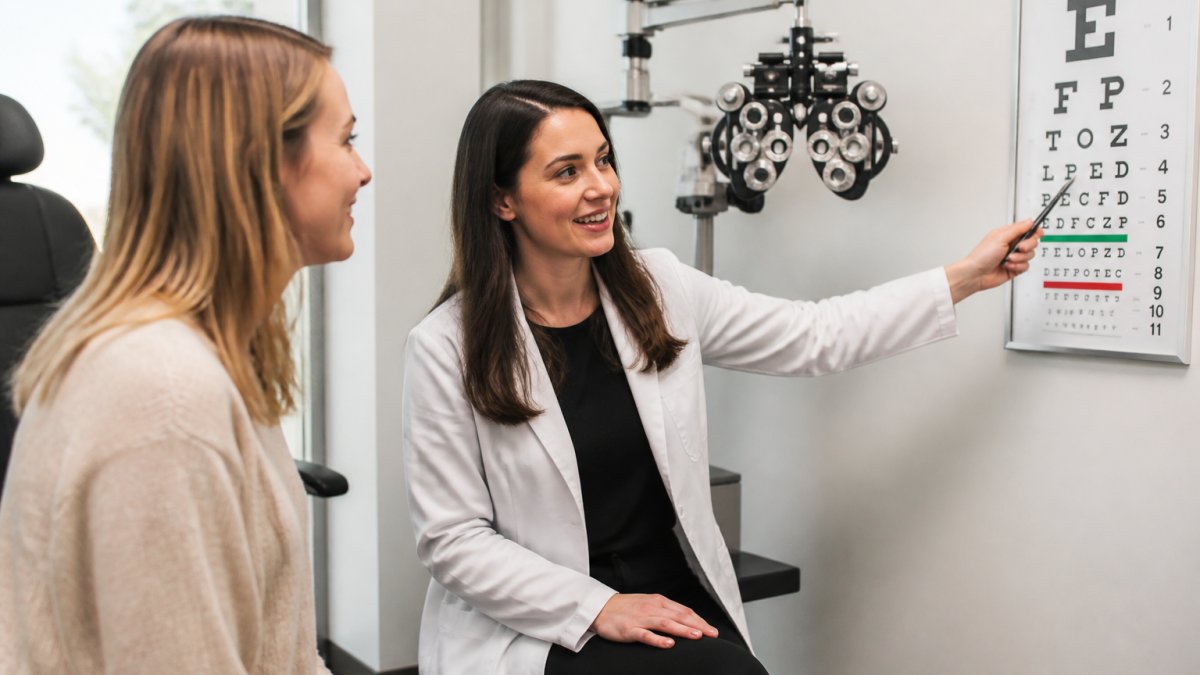
The better or worse test is the part where the optometrist flips lenses and asks, “Which is clearer, one or two?” It is called subjective refraction, and it depends entirely on your answers.
This is why it can feel quick. The optometrist is not rushing; they are narrowing options based on each reply. Answer honestly and take a second if you need one. Guessing to speed things up gives a worse prescription.
How to Prepare for an Eye Exam
Preparation is the easiest way to make an exam feel calmer and more thorough. A little homework before you arrive changes how the visit goes.
- Bring your current glasses or contacts, plus any old prescription.
- List your medications and health conditions, including diabetes and high blood pressure.
- Note your symptoms in advance: blurry vision, eye fatigue, tension headaches, near vision blur.
- Track your screen time for a few days if digital eye strain is a concern.
- Write down your questions so you do not forget them in the chair.
- Ask about dilating drops beforehand, since they blur your vision for a few hours.
One common mistake: skipping the list because you think you will remember. You will not, and those details shape the exam.
Questions to Ask Your Optometrist
Asking questions is not rude. It is patient advocacy, and good clinicians welcome it. Here are the ones worth asking:
- How long is my appointment slot?
- Will you check my eye pressure and look at my retina today?
- Is an OCT scan recommended for me, and why?
- Did my prescription change, and by how much?
- Are there signs of digital eye strain or dry eye?
- When should I book my next exam?
- Can you explain what you found in plain language?
If English is not your first language, ask whether staff can explain results in yours. Alcona Eye Care offers multilingual services in English, Spanish, French, Portuguese, and Italian.
Book a Comprehensive Eye Exam at Alcona Eye Care
A thorough exam should leave you with answers, not doubts. We aim to provide care for every age with clear explanations.
Our team of optometrists provides comprehensive exams for adults, seniors, and children, with a focus on compassionate, personalized care. We also offer specialized dry eye management and myopia control. You can learn about our insurance and payment options before you book. You can review our adult and senior eye exams before you book.
Best for: anyone who wants time to ask questions and understand their results.
Skip if: you only need a quick vision screening for a form.
Frequently Asked Questions
Why do eye exams feel so quick?
A short visit can still cover a lot, depending on your history and concerns. The rushed feeling often comes from the pace of the appointment and the number of tests packed into it, not from skipped steps. If you leave with unanswered questions, ask for a longer appointment or book a comprehensive eye exam where you can discuss your history and concerns in detail.
How long should a comprehensive eye exam take?
The length of a comprehensive eye exam depends on your age, your eye health history, and whether you need a prescription update. A vision screening at school or work is much shorter, often 5 to 10 minutes, and does not replace a full exam. If your appointment feels much shorter than that and you have specific concerns, ask your optometrist what was checked and whether any follow-up tests are needed.
Can I ask my optometrist to explain each test?
Yes. You can ask for an explanation at any point during the exam, and a good optometrist will welcome the question. Before the tests begin, say that you would like to understand what each step is for. This helps you follow the process, reduces the feeling of being rushed, and gives you a chance to mention symptoms like eye fatigue, tension headaches, or blurry vision that might otherwise go unmentioned.
What should I do if I feel rushed during an eye exam?
Speak up during the appointment rather than after. Ask the optometrist to slow down, repeat a test, or explain the results. If the schedule is too tight, request a follow-up visit to cover your remaining questions. You can also prepare a short list of questions to ask your optometrist before you arrive, which keeps the conversation focused. If the rushed feeling continues at every visit, it may be worth looking for a provider whose appointment lengths match your needs.
If your last exam left you with more questions than answers, that is a sign to book a visit where you are not watching the clock. Get started with Alcona Eye Care and book a comprehensive exam with time built in for your questions.