Last Updated: October 29, 2026
Quick Summary
Myopia control for school children is the clinical practice of slowing how quickly nearsightedness worsens while a child’s eyes are still growing. Ordinary glasses correct the blur, but myopia control aims at the progression itself, with options including specialty contact lenses, myopia control glasses, and low-dose atropine eye drops.
- Progression is usually fastest in the early school years and can continue into the late teens.
- A comprehensive eye exam is generally recommended before a child starts school, then at regular intervals.
- Orthokeratology uses rigid lenses worn overnight to reshape the cornea temporarily.
- Atropine eye drops are prescribed at low concentration and applied once daily, usually at bedtime.
- Many clinics track axial length because elongation is the underlying driver of progression.
Table of Contents
- Why Myopia Control for School Children Matters
- Signs of Myopia in Children Parents and Teachers Notice
- When School-Age Children Should Have a Comprehensive Eye Exam
- How Myopia Control Differs From Ordinary Vision Correction
- Myopia Management Options for School Children
- Myopia Control Glasses for Kids
- Atropine Eye Drops for Myopia in Children
- Outdoor Time and Myopia in Children
- Safety, Side Effects, and What Treatment Really Costs
- A Practical Monitoring Timeline for Parents and Schools
- Frequently Asked Questions
Why Myopia Control for School Children Matters
Myopia control for school children is the clinical practice of slowing how quickly nearsightedness worsens while a child’s eyes are still growing. At Alcona Eye Care, we treat this as a time-sensitive issue rather than a routine prescription update, because the earlier a child is identified, the more options remain open.
Myopia is a refractive error in which the eyeball grows slightly too long or the cornea curves too steeply, so light focuses in front of the retina instead of on it (Myopia (Nearsightedness)). The result is blurred distance vision: a child can read a book up close but struggles to see the board at the front of a classroom.
That distinction matters. Ordinary glasses correct the blur. Myopia control tries to change the trajectory underneath it.
How Nearsightedness Progresses as Eyes Grow
Most childhood myopia is progressive. The eyeball elongates during growth years, and each fraction of a millimetre of elongation typically pulls the prescription higher. Progression is usually fastest in the early school years and can continue into the late teens.
Two children with the same starting prescription can follow very different paths. Age of onset is one of the strongest signals: a child who becomes nearsighted at six or seven generally has more growing years ahead, and therefore more room for the prescription to climb, than a child who becomes nearsighted at twelve.
Family history adds another layer. When one or both parents are nearsighted, a child’s risk rises, though a child with no family history can still develop myopia.
Signs of Myopia in Children Parents and Teachers Notice
The earliest signs of myopia in children are usually behavioral, not verbal. Children rarely say “my distance vision is blurry” because they have no baseline for comparison. They adapt instead.
Watch for these patterns:
- Squinting, head tilting, or squishing one eye to see the board
- Moving much closer to the television or holding a book unusually near the face
- Complaints of headaches or tired eyes after school
- Falling behind in copying from the board, or asking to sit at the front
- Losing interest in sports that require distance vision, like ball games
- Rubbing eyes frequently, which can also signal digital eye strain from screen time
Teachers often spot it first. A child who copies the wrong homework questions, or who stops volunteering answers, may simply not be seeing clearly. If a teacher raises a concern, treat it as a prompt to book an assessment rather than a diagnosis.
When School-Age Children Should Have a Comprehensive Eye Exam
A comprehensive eye exam is a full assessment of vision, eye health, and focusing skills, not a quick screening. A comprehensive eye exam is generally recommended before a child starts school, then at regular intervals through the school years as advised by an eye-care professional, sooner if a parent or teacher notices changes.
Vision screenings at school catch some problems but miss others. A screening measures distance acuity; a comprehensive exam also checks eye alignment, eye health, focusing ability, and the prescription in each eye separately. A child can pass a screening and still be struggling.
If your child has never had a full exam, our guide to what a comprehensive eye exam involves walks through each step so you know what to expect. Families who want to arrange one can read more about children’s eye exams and how visual skills connect to classroom learning.
How Myopia Control Differs From Ordinary Vision Correction
Standard glasses and contact lenses correct blurred distance vision. They let a nearsighted child see the board clearly, but they do not slow the underlying elongation of the eye. Myopia control aims at the progression itself.
That shift in goal changes everything about the treatment plan: the target is a slower rate of prescription change over years, measured at follow-up appointments, not a single clear pair of lenses.
It also changes the conversation about risk. Higher myopia is associated with a greater chance of retinal complications later in life, so slowing progression is a long-term eye health decision as much as a short-term vision one (Myopia (Nearsightedness)). For families weighing this, our overview of myopia and whether it can be reversed explains what treatment can and cannot do.
Myopia Management Options for School Children
Myopia management is not one treatment. It is a set of options matched to a child’s age, prescription, eye health, and daily routine. Common categories include specialty contact lenses, myopia control glasses, and low-dose atropine eye drops, often used in combination.
Treatment suitability varies. Some children are too young for contact lens handling, some have prescriptions outside a given treatment’s range, and some families prefer the simplest routine. A treatment plan should follow an assessment, not a general recommendation.
Specialty Contact Lenses and Orthokeratology
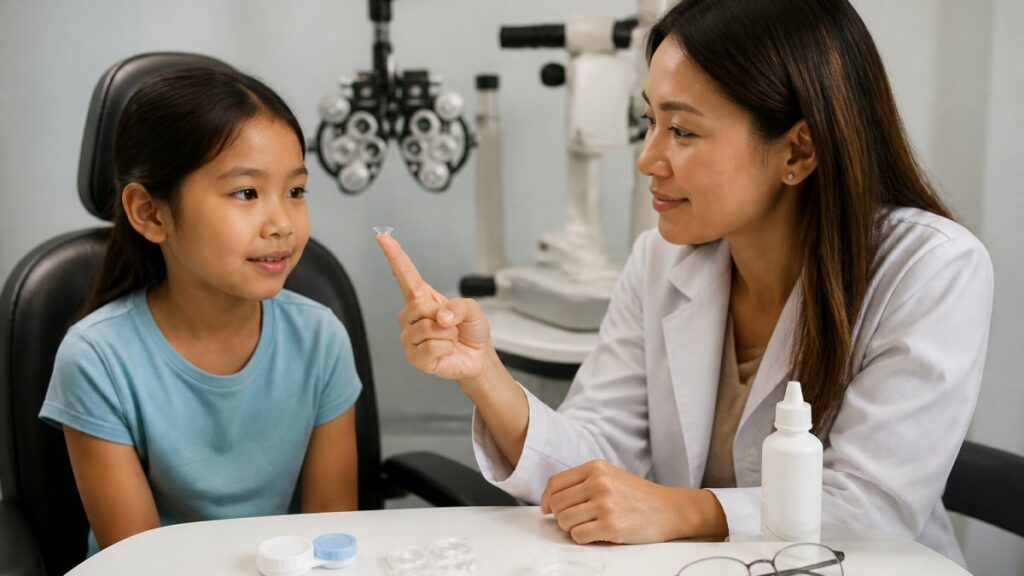
Two contact lens approaches are used in myopia management. Multifocal contact lenses, worn during the day, are designed to reduce the stimulus that drives eye elongation. Orthokeratology uses rigid lenses worn overnight to reshape the cornea temporarily; the child sees clearly the next day without glasses.
Both require good hygiene, reliable handling, and regular monitoring for eye health. Orthokeratology in particular demands consistent follow-up, because the cornea is being reshaped deliberately.
Myopia Control Glasses for Kids
Myopia control glasses for kids look like ordinary spectacles but use lens designs intended to slow progression rather than only correct blur. They suit children who are not ready for contact lenses or whose families prefer a no-touch routine.
The trade-offs are honest ones. Glasses are the easiest option to live with and the hardest to lose compliance on, since they come off for sports and sleep. Their effect on progression is generally more modest than contact lens or atropine approaches, so they are often chosen for younger children or as part of a combined plan.
Atropine Eye Drops for Myopia in Children
Atropine eye drops for myopia in children are prescribed at low concentration and applied once daily, usually at bedtime. The drops are thought to act on the mechanisms that drive eye growth rather than simply relaxing the focusing muscle.
They are a prescription treatment, not an over-the-counter purchase, and they require monitoring for side effects such as light sensitivity and near-blur. Adherence matters: a drop routine only works if it is followed consistently, which is why we match the schedule to the family’s evening routine rather than the other way around.
Outdoor Time and Myopia in Children
Time outdoors is the one prevention habit with broad support and no prescription attached. Research suggests that children who spend more time outside in natural light may show slower myopia progression, though outdoor time is not a treatment on its own.
Practical targets for a school week:
- Aim for accumulated outdoor time most days, broken into short blocks rather than one long session
- Use recess and the walk to and from school as built-in outdoor time
- For near work and screen time, keep reading distance at roughly an arm’s length and build in regular breaks
- Balance screen time with distance viewing, since prolonged close focus is a known strain on young eyes
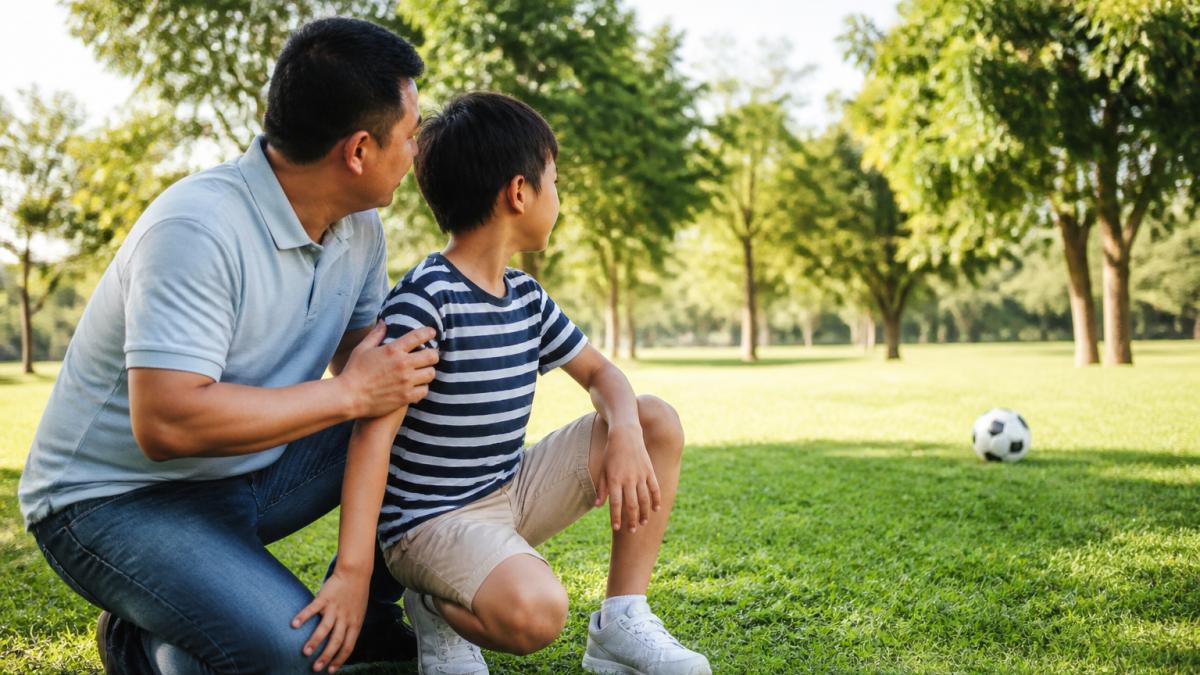
Screen habits and outdoor habits are two sides of the same coin. Families managing heavy device use alongside myopia risk may find our guidance on digital eye strain useful for the screen-time side of the plan.
Safety, Side Effects, and What Treatment Really Costs
Myopia control treatments carry different risks and side effects, which should be discussed with an eye-care professional before starting. Contact lens wear carries a small infection risk if hygiene slips. Atropine can cause light sensitivity and near-blur in some children. Glasses carry essentially no safety risk but depend on the child actually wearing them.
Costs vary by treatment, by the monitoring schedule it requires, and by whether a family’s insurance plan includes coverage. Costs vary by treatment and by the monitoring schedule it requires. For current pricing or a quote, please visit the Alcona Eye Care website or contact the clinic directly, and check what your insurance plan covers.
A Practical Monitoring Timeline for Parents and Schools
Monitoring is where myopia control succeeds or fails. The plan below is a general framework, not a substitute for a schedule set at a consultation. What matters is that follow-up is regular, that the same measurements are repeated so trends are visible, and that parents and teachers know what to watch between visits.
What Clinicians Measure
At follow-up, an eye-care professional typically checks the prescription in each eye, eye health, and how well the treatment is being tolerated. Many clinics also track axial length, the front-to-back measurement of the eye, because elongation is the underlying driver of progression. Tracking axial length alongside prescription gives a clearer picture of whether the treatment is actually slowing eye growth rather than just holding the prescription steady for a while.
A General Monitoring Framework
| Timeframe | What Happens | What to Watch |
|---|---|---|
| Baseline visit | Full exam, prescription, eye health, axial length if available, treatment discussion | Establish starting point |
| 1-3 months after starting | Check tolerance, side effects, adherence | Comfort, drop routine, lens handling |
| Every 6 months | Prescription and eye growth measured | Rate of change versus baseline |
| Annually | Full review of treatment response | Whether the plan still fits |
| Any time symptoms change | Unscheduled check | New blur, headaches, squinting |
A common pattern is that the first year gives the clearest signal: if progression slows compared with the expected rate for the child’s age, the plan is working. If not, the clinician may adjust the treatment or combine options.
How Families Can Tell If the Plan Is Working
Parents do not need to interpret measurements alone. Ask at each visit for the prescription and, where tracked, the axial length, and how they compare with the previous visit. A plan is generally considered to be working when the rate of change is slower than what would be expected without treatment. Ask the clinician to explain the trend in plain language and to say what would prompt a change in approach.
The School’s Role
Schools cannot diagnose myopia, but they can support the clinical plan at no cost. Practical steps include:
- Seat a known myopic child where they can see the board clearly, and review seating if the child reports new blur.
- Flag changes in copying from the board, participation, or squinting, and share them with parents rather than waiting for a report card.
- Protect recess and outdoor time, since time outdoors is the one prevention habit with broad support.
- For screen-based classwork, build in regular breaks and encourage distance viewing.
A simple communication routine helps: parents tell the teacher about the treatment plan and any vision changes, and the teacher tells parents about classroom observations. A short note at the start of each school year can prevent months of unnoticed struggle.
Frequently Asked Questions
What is myopia control for children?
Myopia control is a set of treatments that aim to slow how quickly nearsightedness gets worse in a child, rather than only correcting the blur with standard glasses. Options include low-dose atropine eye drops, specialty contact lenses, orthokeratology, and myopia control glasses for kids. An optometrist assesses your child’s prescription, eye growth, and lifestyle to recommend a treatment plan, then monitors prescription changes and axial length over time to see how well it is working.
How can I tell if my school-age child is becoming nearsighted?
Common signs of myopia in children include squinting at the board, holding books or screens very close, sitting near the front of the class, complaining of blurred distance vision, and frequent headaches or eye strain after school. Some children rub their eyes a lot or seem to lose interest in activities that need clear distance vision, like sports. These signs are not a diagnosis, so book a comprehensive eye exam with an optometrist to confirm whether a refractive error is present.
At what age can a child start myopia control?
Many children can be considered for myopia management once nearsightedness is detected, which often happens between ages 6 and 12 as eyes grow. Suitability depends on the prescription, age of onset, family history, and how well your child can handle the treatment, especially contact lenses. An optometrist will discuss treatment suitability and whether a child is ready for drops, specialty lenses, or glasses. Earlier detection generally gives more room to slow progression.
Do myopia control glasses work for school children?
Myopia control glasses for kids use special lens designs intended to reduce the stimulus that drives eye growth, and they can slow progression in some children. They are non-invasive and easy for a child to wear at school, which helps adherence. Results vary between children, and some prescriptions progress despite treatment. Your optometrist will compare glasses with other options like atropine eye drops or specialty contact lenses and monitor prescription changes at follow-up appointments.
Can outdoor time help reduce the risk of myopia in children?
More time outdoors is linked with a lower risk of developing myopia and with slower progression in some studies, though it is not a treatment on its own. Aim for regular outdoor play, ideally in daylight, and balance it with sensible near-work habits: keep reading distance comfortable, take breaks from screens, and avoid prolonged close work. Outdoor time and myopia in children is best treated as part of a broader plan alongside professional monitoring.
How often should a child with myopia have an eye exam?
Children in myopia management are usually seen more often than once a year, often every 6 to 12 months, so the optometrist can track prescription changes, axial length, and treatment response. Follow-up appointments also catch side effects early and confirm adherence. Between visits, note any new squinting, headaches, or school concerns. Ask your optometrist for a monitoring schedule that fits your child’s age and treatment, and keep a simple record of exam dates and prescription changes.