
Quick Summary
To find a local optometrist families can trust, start by listing each person’s age, symptoms and eye care needs. Then confirm licensure through your provincial regulatory college and compare nearby clinics on hours, parking, wait times and whether they see children and adults.
- Confirm any optometrist’s licence on your provincial regulatory college’s public register.
- Compare shortlisted clinics on evening hours, parking, accessibility and new-patient wait times.
- Ask whether the clinic examines young children and how it adapts testing for pre-readers.
- Ask by phone about coverage and out-of-pocket costs before booking, since fees and rules vary.
- Ask whether siblings can book back-to-back appointments to save a trip.
Table of Contents
- Start With Your Family’s Eye Care Needs
- How to Search for a Local Optometrist Near You
- How to Choose an Optometrist for Children and Adults
- Children’s Eye Exams: What to Plan For
- Checking Optometrist Credentials and Questions to Ask Before Booking
- Booking Your Family’s First Visit to Alcona Eye Care
- Frequently Asked Questions
Start With Your Family’s Eye Care Needs
Finding the right optometrist for your family starts at home, not on a search engine, and the search for local optometrist families begins with a clear picture of everyone’s needs.
Write down a short list for each family member:
- Age and last exam: When was the last comprehensive eye exam?
- Symptoms: Headaches, squinting, trouble reading, eye strain after screen use, or dry or irritated eyes?
- School or work demands: Does the child need help with reading or sports? Does an adult spend many hours on screens?
- Existing conditions: Is anyone managing a known eye condition or using contact lenses?
This list shapes your search. A family with a young child needs a provider who handles children’s exams well. A family with an older parent may need ongoing management for age-related eye conditions.
How to Search for a Local Optometrist Near You
Start with two or three trusted search methods, then compare what you find. No single source shows every option, and each one has blind spots.

Using Provider Directories and Association Listings
Begin with the provincial optometric regulatory body where you live. These colleges maintain public registers of licensed optometrists, so you can confirm a provider is registered and in good standing before you ever call.
Layer in a professional association directory, such as the national or provincial optometric association listing, and a general map search.
Watch out: directory listings can go stale, so confirm hours, new-patient status and services on the clinic’s own website or by phone before you book.
Searching by Address or Postal Code
A postal-code or address search is the fastest way to build a shortlist, but treat distance as a starting filter, not the deciding factor. Enter your postal code into a map search and note every clinic within a realistic trip, then check the details that actually affect whether you will keep the appointment:
- Hours that match your life: evening or weekend slots matter for working parents and school-age children.
- Parking and transit: confirm lot or street parking, and whether a bus or train stop is close.
- Accessibility: step-free entry, accessible washrooms, and space for a stroller or wheelchair.
- Language: ask which languages the optometrist and staff speak if that affects comfort or consent.
A clinic ten minutes closer is not the better choice if it cannot see a child after school or has a three-month wait. Compare two or three shortlisted clinics on these points side by side before deciding.
Confirming the Clinic Is Right for Your Family
Once you have a shortlist, do a quick verification pass. Check the regulatory register for licensure, then look for signs the practice handles the ages in your household, a services page that names children’s exams, adult care and senior eye health is a better signal than a generic “family eye care” line.
This step turns a list of nearby names into a shortlist you can actually book from.
How to Choose an Optometrist for Children and Adults
Not every optometrist is equally suited to every age group. Some practices focus on children’s vision, while others focus on adult or senior care. Many serve the whole family, which can make scheduling easier.
Use this checklist to compare options:
- Offers comprehensive eye exams for children and adults
- Has experience with children’s vision and school-age concerns
- Provides ongoing care for age-related conditions such as glaucoma and macular degeneration
- Offers contact lens fittings if your family needs them
A family-friendly practice often schedules appointments for several people in a row, which saves a trip. Ask whether siblings can book back to back.
Children’s Eye Exams: What to Plan For
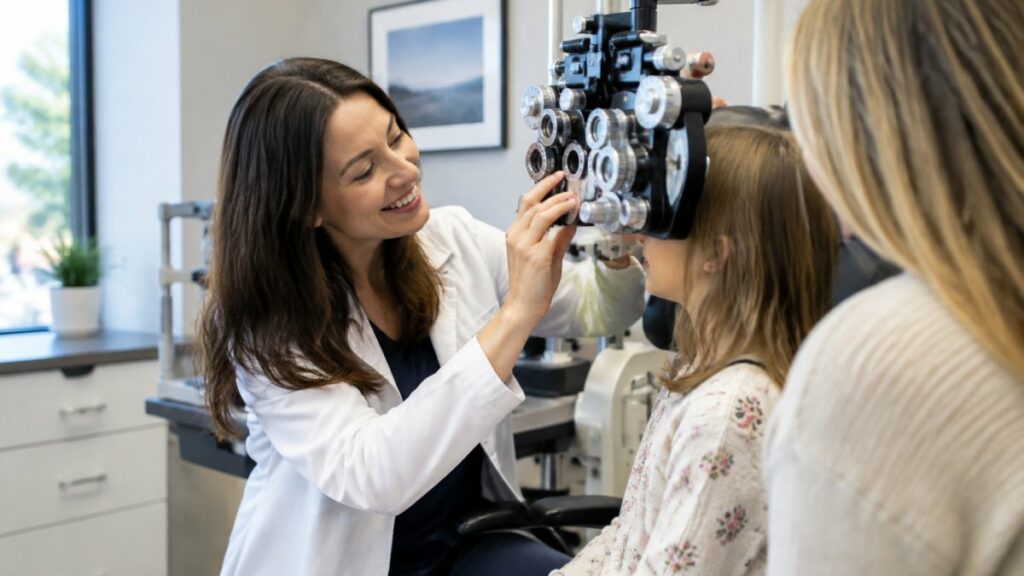
Children need comprehensive eye exams because vision affects learning, reading, sports and daily activities (Start the school year with a comprehensive eye exam).
When you plan a child’s exam, prepare these things:
- Bring a list of concerns. Note any squinting, rubbing of eyes, or trouble reading.
- Share school feedback. If a teacher has flagged vision concerns, bring that note.
- Bring current glasses or contacts. The optometrist can check how well they fit and perform.
- Plan for dilation if needed. Some exams use eye drops that blur near vision for several hours, so arrange transport.
If your child has been flagged at school, ask the optometrist about options for managing vision changes. Ask what the plan involves and how often follow-up visits will be needed.
Before a child’s exam, a few preparations help the visit go smoothly and the results prove useful.
| Preparation | Why it matters | Note |
|---|---|---|
| List concerns | Captures squinting, eye rubbing, reading trouble | Note any you notice |
| Share school feedback | Teacher flags inform the exam | Bring the note |
| Bring current glasses or contacts | Checks fit and performance | Bring them along |
| Plan for dilation | Drops blur near vision for hours | Arrange transport |
Checking Optometrist Credentials and Questions to Ask Before Booking
Before you book, confirm two things: that the optometrist is licensed, and that the practice fits how your family actually uses care. Then get clear on cost so there are no surprises at the front desk.
Verifying Credentials and Scope of Care
Licensure is the baseline. Every province has a regulatory college that maintains a public register; search the optometrist’s name there to confirm registration and good standing.
Scope of care varies by province, so ask what the optometrist can do in your jurisdiction.
For children, ask about pediatric experience directly: the youngest age they examine, how they adapt testing for pre-readers, and how they handle a child who is anxious or uncooperative.
Questions to Ask by Phone or Email
A short call or email before booking saves a wasted visit. Ask:
- Are you accepting new patients, and for which ages?
- Do you see children, adults and seniors at the same clinic?
- How long is a comprehensive exam, and is there time for questions?
- Which languages do you and your staff speak?
Pay attention to how the clinic answers. A practice that takes time with your questions before you book is often a good sign for the visit itself.
Understanding Coverage and Out-of-Pocket Costs
Cost is where families most often get caught out, so ask before you book. Provincial health coverage for eye exams varies by province and age, so check what applies where you live.
Ask the clinic these questions:
- Which parts of the exam are covered by provincial health coverage for each age in my family?
- Do you bill my private insurer directly, or do I pay upfront and submit a claim?
- What does a comprehensive exam cost if I pay out of pocket?
- Are there separate fees for follow-up visits, contact lens fittings or additional testing?
Watch out: coverage rules and fee schedules change, and a clinic’s website may not reflect current amounts, so confirm the numbers by phone and check your own plan booklet for what it reimburses.
Booking Your Family’s First Visit to Alcona Eye Care
Once you have your list, your location search and your questions, you are ready to book. Learn more about our practice and our team before you book your family’s first visit.
If your child needs a checkup, review the children’s eye exam services so you know what to expect. For adults and seniors, the adult and senior eye exam options explain the comprehensive care we offer. Before you call, check insurance and payment information so you know what to expect at the front desk. Finally, confirm the Innisfil location details so you can plan the trip.
Call the clinic or visit the website to book. Bring your family’s list, your questions and any school or medical notes.
Finding a local optometrist for your family takes planning, but the right provider can look after every age in your home.
Frequently Asked Questions
How do I choose an optometrist for my family?
Start by confirming the optometrist accepts new patients of all ages, since some practices limit care to adults or specific age groups. Look at whether the office has an appointment schedule that fits school and work hours, whether staff communicate clearly with children and parents, and whether the practice can manage both routine exams and ongoing conditions. Call the office to ask these questions before booking. A short phone call usually tells you more than a website does about how the practice handles family visits.
Can one optometrist see both children and adults?
In most cases, yes. Many optometrists provide comprehensive eye exams for patients from infancy through older adulthood, so a single provider can often care for the whole family. Confirm this directly with the office, because practices vary in their focus. If a child has a specific concern such as a suspected lazy eye or a sudden change in vision, ask whether the optometrist has experience with that issue or whether a referral would be better.
What should I expect at a child’s first eye exam?
A first eye exam for a child is usually gentle and includes tests of how well each eye sees, how the eyes work together, and the health of the eye structures. Many children are tested with games or picture charts rather than letter charts. The optometrist may also check focusing ability and eye alignment. Bring a list of any concerns you have noticed, such as squinting, headaches or trouble reading, because these details help the optometrist plan the visit.
How can I check an optometrist’s credentials?
Look for the optometrist’s name, the Doctor of Optometry designation, and their provincial licence or registration. Optometrists are regulated provincially, and you can confirm that a provider is registered through your province’s regulatory college’s public register. Ask the office about any areas of special interest, such as paediatric care or management of eye conditions, and ask how long the optometrist has practised. The credentials that matter most are those verified through the regulator rather than those listed only on a marketing page.